The 6 Best Privacy-First Analytics Platforms: Complete Comparison
 Leon Bauer
·
·
·
22 min read
Leon Bauer
·
·
·
22 min read
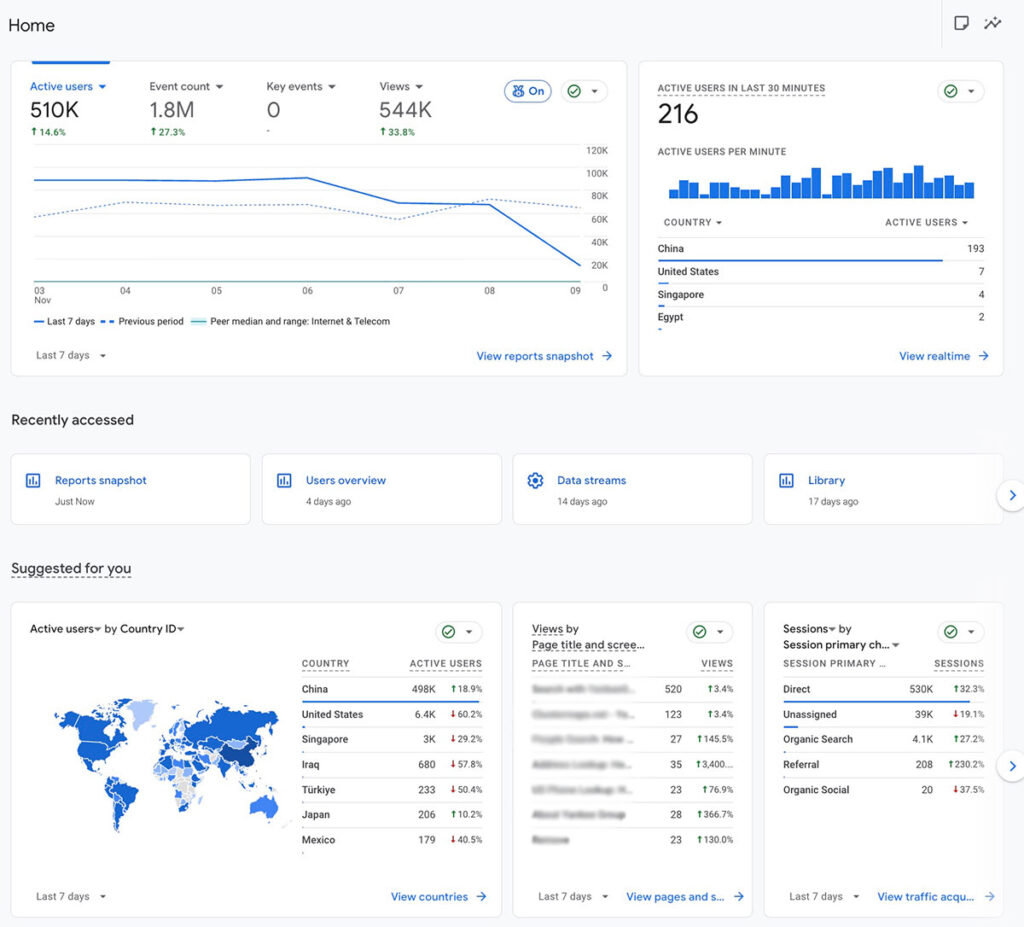
Most website owners reach for Google Analytics by default. It’s free, it’s familiar, and it’s everywhere. But “free” comes with a cost — your visitors’ data feeds Google’s advertising machine, your site likely needs a consent banner (which most people dismiss or ignore), and your analytics are legally questionable across half of Europe. Privacy-first analytics offers a fundamentally different deal: you get the traffic insights you need, your visitors get genuine privacy protection, and you stay on the right side of GDPR, CCPA, and every data regulation that comes after.
This guide covers the six platforms that have earned the privacy-first label honestly — not just through marketing, but through architecture. We compare Fathom, GoatCounter, Matomo, Plausible, Statable and Umami across cookieless tracking, hosting options, GDPR compliance, pricing, and API access. No hype — just straight answers.
If you want the strategic case for making the switch, Leon’s piece on why privacy-first analytics is a business advantage is a good companion read. But if you’re ready to pick a tool, let’s break this down together.
What Makes Analytics Truly Privacy-First?
The phrase “privacy-focused” gets thrown around a lot, but there’s a concrete technical meaning behind it. A privacy-first analytics platform does three specific things differently from Google Analytics.
No persistent identifiers. Traditional analytics platforms assign each visitor a cookie-based ID that persists across sessions and often across sites. Privacy-first tools don’t. They either skip individual identification entirely (GoatCounter, Plausible) or rely on daily-rotated, salted hashes that cannot be reversed to identify a person (Fathom, Umami).
No third-party data sharing. When you run GA4, Google receives your visitor data and uses it across its advertising network. With privacy analytics software, data goes to your server — or to a vendor whose entire business model is analytics subscriptions, not ad targeting.
No consent banner required (in most setups). Because these tools don’t store cookies or collect personally identifiable information, many of them operate legally without a cookie consent popup under GDPR Article 6. That’s not a loophole — it’s the design. As a result, you also get more accurate data: consent banners suppress 30–60% of measurements when visitors decline.
For a deeper look at how cookies and tracking actually work under the hood, see the primer on cookies and tracking explained simply.
Privacy-First, Privacy-Friendly, Privacy-Focused: What the Labels Mean
Vendors use those three phrases almost interchangeably, and buyers pay for the difference. Separating them takes a minute and saves a bad shortlist.
Privacy-first describes architecture. The tool cannot identify an individual because it was never built to — no cookie, no persistent ID, no cross-site graph, and no setting that turns identification back on. GoatCounter and Plausible sit here by construction.
Privacy-friendly usually describes configuration. The tool is capable of collecting personal data but ships with the invasive parts switched off, or offers a mode that strips them. Matomo is the honest example: run it in cookieless mode and it behaves like a privacy-first tool; leave the defaults alone and it stores visitor IDs like any classic analytics package. Privacy-friendly analytics is a promise about how the software is set up, and setups drift.
Privacy-focused is marketing. It carries no technical commitment whatsoever, and plenty of tools that fingerprint browsers or resell audience segments print it on their homepage. Treat privacy-focused analytics as a claim to verify, never as a category.
The phrase private analytics confuses things further, because it gets used for two unrelated ideas: analytics that keep the visitor private, and analytics whose dashboard is private to you. Those pull in opposite directions — several tools on this list will happily publish a public dashboard while collecting nothing about the people in it.
So ignore the label on the box and ask one question of every vendor: what identifier does this tool write to my visitor’s device, and how long does it live? A cookie that survives two years, a hash that resets at midnight and a session key that expires in eight hours are three different legal positions, and the answer is usually one line in the vendor’s own documentation.
Quick Comparison: 6 Privacy-First Analytics Platforms
Before we dig into each platform, here’s the snapshot you need. Five of the six run without cookies out of the box and Matomo gets there once you switch the setting on; all are GDPR-ready, and all provide some form of API. The differences come down to hosting model, depth of features, and price. Every price below came from the vendor’s own pricing page on the day this comparison was last updated, and it is worth repeating that check before you commit — plans in this category get restructured without much announcement. If the numbers still look steep, the breakdown of what free analytics actually costs you is the counterweight.
| Platform | Cookieless? | Hosting | GDPR-Ready | Free Tier | API |
|---|---|---|---|---|---|
| Plausible | Yes — no cookies, no persistent IDs | Cloud (EU) or self-hosted | Yes — EU servers, data processing agreement available | 30-day trial; self-hosted free | Yes — stats, sites, goals |
| Fathom | Yes — cookieless, GDPR-exempt by design | Cloud; free self-hosted Fathom Lite (reduced features) | Yes — EU isolation option; no consent banner needed | No free tier; 7-day trial | Yes — full REST API |
| Matomo | Optional — cookieless mode available | Cloud (Matomo.cloud) or self-hosted | Yes — self-hosted = full control; cloud on EU infra | Self-hosted free; 21-day cloud trial | Yes — reporting, tracking, admin APIs |
| Umami | Yes — no cookies by default | Cloud or self-hosted | Yes — no PII collected; self-hosted = full data sovereignty | Yes — Hobby plan free (100K events/mo, 1 website) | Yes — on paid cloud plans and self-hosted |
| GoatCounter | Yes — no cookies, no JS fingerprinting | Cloud or self-hosted | Yes — no personal data collected at all | Yes — hosted service free for reasonable public use | Yes — read/write API |
| Statable | Yes — no cookies, no persistent identifiers | Cloud (EU — Netherlands) | Yes — data stored in the EU | Free for .edu and GitHub/GitLab Pages sites; otherwise 30-day trial | Yes — JavaScript event API |
Now let’s go platform by platform — what each one does well, where it falls short, and who it’s really built for.
Plausible: Privacy-Focused Analytics for WordPress and Beyond
Best for: Non-technical teams, WordPress sites, e-commerce
Official site: plausible.io
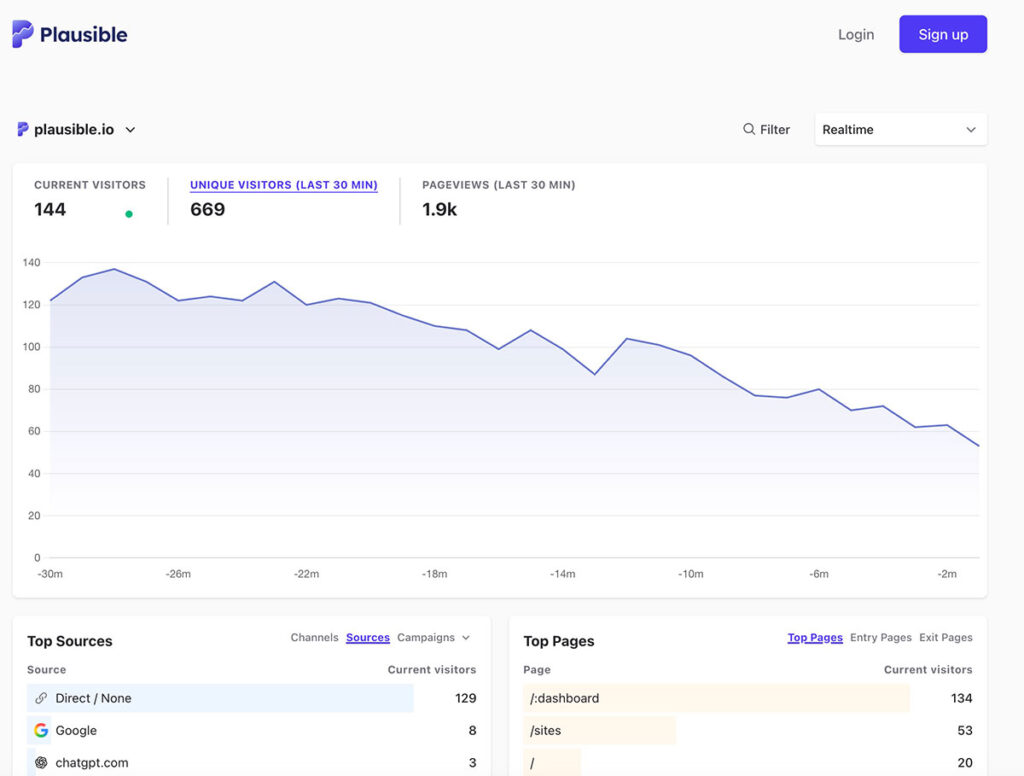
Plausible is built by a two-person team in Estonia and has grown into arguably the most popular privacy-first analytics platform in the English-speaking world. The philosophy is radical simplicity: one screen, essential metrics, no configuration maze.
What Plausible Does Well
- Script weight around 1 KB — far lighter than GA4’s tracking script
- EU-hosted cloud — data never leaves European infrastructure by default
- No cookies, no consent banner needed under most GDPR interpretations
- Official WordPress plugin with native WooCommerce integration
- Google Search Console import — keyword data alongside traffic in one view
- Public dashboards — share stats openly with clients or your audience
- Email reports and spike alerts — weekly digests without logging in
Pricing
Cloud pricing is split across three named plans, each of which then scales with the monthly pageview volume you pick. Starter opens at $9/month for one site and up to 10k monthly pageviews. Growth opens at $14/month and covers up to three sites and three team members. Business opens at $19/month for up to ten sites and ten team members, and it is the plan that carries funnels, user journeys, ecommerce revenue attribution, the Stats API, the Looker Studio connector and five years of data retention. Above that, Enterprise is a custom quote. Annual billing takes two months off the year, and the 30-day trial does not ask for a card. The self-hosted Community Edition is free under the AGPLv3 — you pay for the server and nothing else.
Trade-offs
No heatmaps, no session recordings, no deep user-level analysis. Plausible is intentionally aggregate-only: if you need to watch individual session replays, this isn’t your tool. The Community Edition also runs on a slower clock — long-term releases land twice a year against the cloud’s weekly updates — and four things stay cloud-only: marketing funnels, user journeys, ecommerce revenue goals, and SSO with the Sites API. Bot filtering is sharper on the hosted version too, which shows up as cleaner numbers rather than as a feature you can point at.
Fathom: Privacy Analytics That’s GDPR-Exempt by Design
Best for: Businesses that need legal certainty, agencies, sites with EU audiences
Official site: usefathom.com
Fathom was started in 2018 by Jack Ellis and Paul Jarvis, and it has a very specific positioning: the analytics tool you use when your legal team is involved. Fathom’s architecture is designed to be GDPR-exempt — not just compliant, but exempt — because it processes no personal data at all in the EU sense.
What Fathom Does Well
- EU isolation — EU visitor data is processed exclusively on EU servers, never transferred to US
- No consent banner required — Fathom has received legal opinion confirming its GDPR-exempt status
- Cookieless tracking — uses a rotating, non-reversible hash; no persistent identifier stored
- Uptime SLA — 99.9% uptime guarantee with status page
- Full REST API — query stats, events, and site data programmatically
- GA4 importer — bring historical data in on day one
- Email reports — daily, weekly, or monthly digests with comparison periods
Pricing
Fathom starts at $15/month for up to 100K pageviews and climbs to $470/month at 25M, with 200K at $25 and 500K at $45 along the way; annual billing charges ten months for twelve at every rung. There’s no free tier — only a 7-day trial. Sites are bundled rather than metered: every plan carries at least 50 of them, the 1M plan carries 75, and the largest plans run into the hundreds. Outgrow the allowance and extra sites come in packs of 50 at $10/month, or $100 a year. For an agency holding dozens of client properties that is still the friendliest site economics in this group.
Trade-offs
The paid product is cloud only, so you’re trusting Fathom’s infrastructure regardless of your own data-sovereignty preferences. There is a self-hosted escape hatch — Fathom Lite, free and open source on GitHub — but it is a stripped-back build: no device, browser or country breakdowns, no events, no email reports, and no support desk. Fathom’s own summary of it is blunt: “With Lite, you’re on your own.” If you want server-side control together with the full feature set, Plausible or Umami fit better. And there’s still no free tier on the hosted product.
Matomo: The Enterprise Privacy Analytics Software
Best for: Enterprises, agencies, regulated industries, teams migrating from GA4
Official site: matomo.org
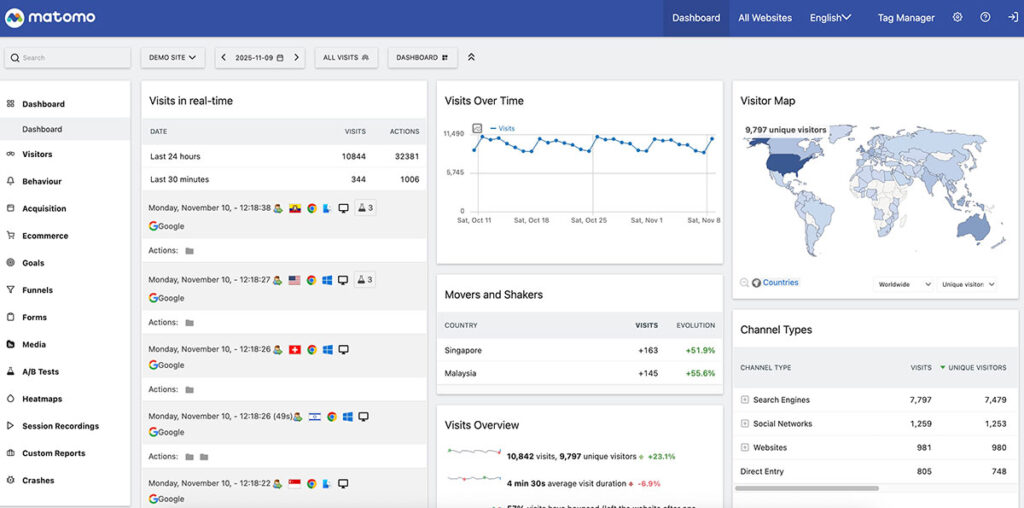
Matomo is the heavyweight in this list — the platform you choose when you need every feature GA4 has, plus the data ownership and GDPR compliance GA4 can never provide. It’s been around since 2007 (originally as Piwik) and has a much larger feature surface than any other tool here.
What Matomo Does Well
- Cookieless mode available — enable it in settings; note that cookieless reduces some metrics precision
- Full data ownership — self-hosted means your data never leaves your servers
- Heatmaps and session recordings (premium plugin or cloud)
- A/B testing framework built in
- E-commerce tracking — native WooCommerce integration, revenue attribution
- 100+ integrations — CRMs, CDPs, tag managers, data warehouses
- Comprehensive API — reporting, tracking, admin, and segment APIs
- GDPR Manager tool — built-in data subject request handling
Pricing
Self-hosted Matomo is free and open source (GPL-3.0 license). You pay only for hosting — a small VPS runs from about $10/month. Matomo Cloud starts at $26/month excluding tax for 50,000 hits and includes managed hosting on EU infrastructure plus automatic updates; annual billing gives two months free, and the Cloud trial runs 21 days with no card required. Premium plugins (heatmaps, A/B testing, funnels) come bundled into Cloud plans; on self-hosted they are sold as paid bundles that start at €275/month for the Team tier, which is the line item people miss when they budget a self-hosted rollout.
Trade-offs
Matomo’s tracking script runs around 22 KB — lighter than GA4 but heavier than the minimalist options. Setup is more involved than Plausible or Fathom, especially for self-hosted. If you want a simple one-page dashboard, Matomo will feel like overkill. But if you need the analytical depth, there’s nothing else in this category that comes close.

Umami: Lightweight Privacy-Friendly Analytics
Best for: Developers, small teams, anyone self-hosting on a budget
Official site: umami.is
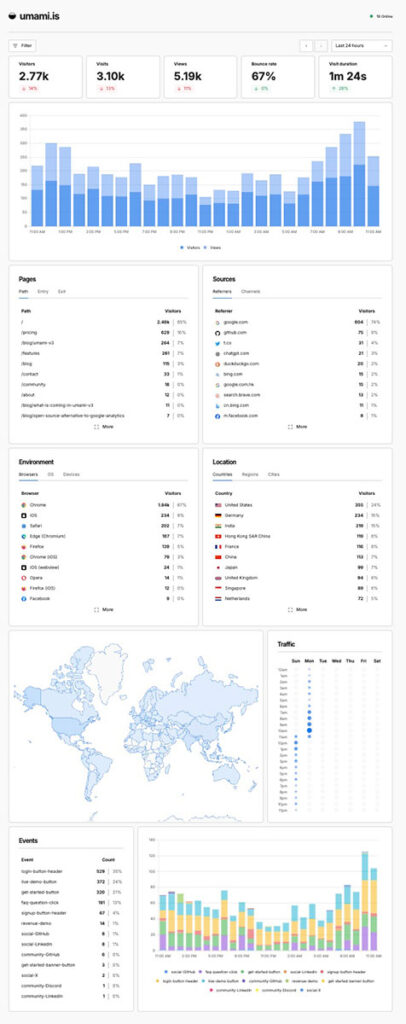
Umami is the developer’s choice. It’s open source, runs on Node.js with PostgreSQL or MySQL, deploys easily with Docker, and has a clean dashboard that non-technical stakeholders can actually read. The script is roughly 2 KB — fast and unobtrusive.
What Umami Does Well
- Cookieless by default — no persistent identifiers, no personal data stored
- 2 KB script — minimal page load impact
- Custom event tracking — track button clicks, form submissions, purchases
- Multi-site support — manage multiple properties from one instance
- Team collaboration — role-based permissions for unlimited team members
- Journey reports — visualise multi-step user paths
- Full REST API — export and query data programmatically
- MIT license — the most permissive open source license in this group
Pricing
| Plan | Events/Month | Sites | Cost |
|---|---|---|---|
| Hobby | 100K | 1 | Free |
| Pro | 1M | 20 | $20/month |
| Business | 10M | Unlimited | $200/month |
| Self-Hosted | Unlimited | Unlimited | $0 (server costs only) |
Trade-offs
Heatmaps and session replays do exist here, but not where most people go looking for them: on Umami’s own cloud they are Business-plan features at $200/month, and on self-hosted installs they came with the 3.1 and 3.2 releases rather than with whatever version you deployed a year ago. E-commerce tracking still requires manual event setup — there’s no click-and-done WooCommerce plugin like Plausible offers. The Hobby free tier covers 100K events on a single website with six months of retention and no API access — fine for a personal site, thin for anything past that. Self-hosting removes those limits entirely.
GoatCounter: Minimal Privacy Analytics for the Open Web
Best for: Personal sites, open-source projects, bloggers, developers who want simplicity and transparency
Official site: goatcounter.com
GoatCounter is the odd one out in this list — and that’s a compliment. While every other platform here chases feature parity with GA4, GoatCounter deliberately stays minimal. It counts visits, referrers, browsers, and page paths. That’s most of what most people actually look at anyway.
What GoatCounter Does Well
- No cookies, no JavaScript fingerprinting — uses a session-scoped token that resets every 8 hours
- No personal data collected whatsoever — the most conservative privacy stance in this group
- Works without JavaScript — can track via a 1×1 pixel image, useful for email campaigns or no-JS environments
- Free for non-commercial use on goatcounter.com
- Self-hosted: free, open source (a lightly modified EUPL-1.2)
- API available — query stats and push data via the REST API
- Tiny infrastructure footprint — a single Go binary, runs on minimal hardware
Pricing
The hosted service at goatcounter.com carries no price tag at all. It is, in the author’s words, “currently offered for free for reasonable public usage” — a personal site or a small-to-medium business is fine, sending millions of pageviews a day is not, and heavier traffic is expected to move to self-hosting. Funding comes from donations rather than subscriptions. Self-hosting is always free, under a lightly modified EUPL-1.2. That makes GoatCounter the most accessible option on this list for indie developers and bloggers — with the honest caveat that a donation-funded service run by one person carries a different kind of risk than a subscription does.
Trade-offs
GoatCounter is built by a solo developer (Martin Tournoij) and intentionally limited in scope. It supports basic event tracking, but there are no funnels, no e-commerce tracking, no A/B testing, and no team features. The API is read-focused. If you need any of those capabilities, look elsewhere. But for “how many people are visiting which pages, and from where” — GoatCounter does it better than anything, with zero overhead.
Statable: All Features on Every Paid Plan
Best for: Freelancers and agencies running several sites, teams leaving GA4 who want to keep their history
Official site: statable.com
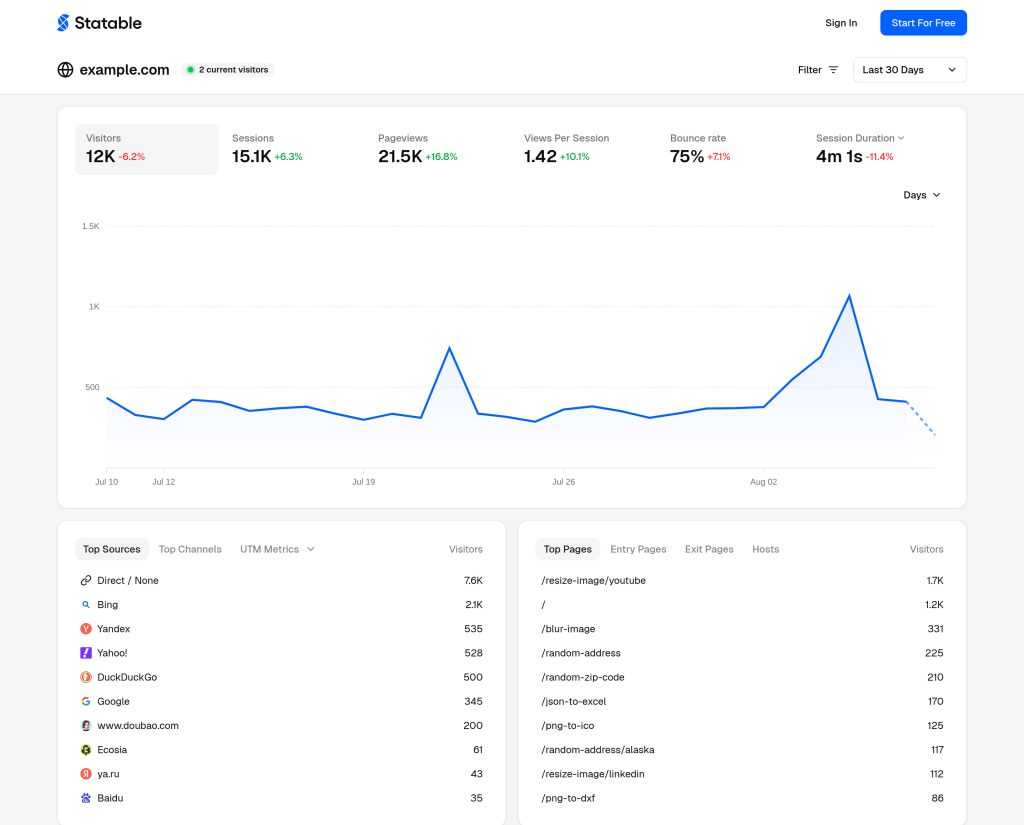
Statable is a hosted, cookieless analytics service with servers in the Netherlands. It sets no cookies and stores no persistent identifiers; raw IP addresses are never stored, and the visitor ID rotates daily.
What Statable Does Well
Pricing runs on a single axis: every paid plan includes the full feature set and an unlimited number of websites, so the price depends only on traffic. That matters once you run more than one project — there is no plan upgrade just to add a site. It also ships a built-in GA4 importer, so your historical data comes with you, plus custom events, funnels and embeddable dashboard widgets.
Pricing
From $9/month for 10,000 pageviews; 100K pageviews costs $19/month. A free tier exists only for .edu domains and GitHub/GitLab Pages sites; everyone else gets a 30-day trial.
Trade-offs
Statable is closed source and cloud-only — there is no self-hosted option, which rules it out for teams that require full infrastructure control. It’s also a newer entrant than Plausible or Matomo, with a shorter track record. And like most cookieless tools, its daily-rotating visitor ID means it can’t follow a visitor across multiple days.
Vendor Longevity Belongs on the Checklist
Privacy analytics is a small market served by small teams, and small teams close. Wide Angle Analytics — an EU-hosted platform run out of Berlin by Input Objects GmbH, and a regular fixture on comparisons like this one — announced in May that it was winding down. The service ran until the end of August 2026, and accounts paid beyond 31 August 2026 were promised a pro-rata refund. The domain now redirects to the parent company and the product pages are gone.
The instructive part is what happens to the data. Wide Angle had no self-service export. Customers are told the company “will prepare a data snapshot in a format following open standards for you to download” and that they will be notified once it is ready. Anyone who assumed they could pull their own history out on the last day is instead waiting on a vendor that is switching off the lights.
Two rules fall out of that, and they apply to every name above. First, find the export path before you sign up and use it during the trial — pull one month of data out while nobody is under pressure, and keep a copy of the file format. Second, weigh how the vendor is funded and what happens if it stops. Matomo, Plausible, Umami and GoatCounter all publish source you can run yourself, so a shutdown costs you a migration weekend rather than your history; a closed cloud product gives you no such fallback, which is a reasonable trade only if you are exporting regularly. If you are in the middle of a move right now, the walkthrough on exporting your analytics data before you switch applies just as well to leaving a privacy tool as to leaving Google.
How to Choose: A Decision Framework
Okay, six platforms — which one is actually right for you? Here’s a practical decision tree.
Choose Plausible if…
You run a WordPress or WooCommerce site and want analytics that work out of the box without touching code. Plausible’s official plugin, clean dashboard, and email digests hit the sweet spot between useful and effortless. Also the right call if you want EU-hosted cloud without the complexity of Matomo.
Choose Fathom if…
Legal certainty is your top priority. Fathom’s GDPR-exempt architecture and EU isolation mode are specifically designed for businesses that can’t afford ambiguity around data compliance. Also a natural fit for agencies managing many sites, since every plan bundles at least 50 of them.
Choose Matomo if…
You’re coming from GA4 and need feature parity — heatmaps, session recordings, A/B testing, e-commerce revenue attribution, deep segmentation. Or if your organization requires full data sovereignty through self-hosting. Matomo is also the strongest option for regulated industries (healthcare, finance, government) where a cloud vendor’s data processing agreement isn’t sufficient.
Choose Umami if…
You’re a developer who wants to self-host privacy-friendly analytics on your own infrastructure at minimal cost. The free Hobby plan covers personal projects; the $20/month Pro plan handles most small businesses. The MIT license gives you maximum freedom to extend or customise.
Choose GoatCounter if…
You want the absolute minimum — page views, referrers, and nothing else — on a tool that has the smallest possible footprint and the strictest privacy posture of anything here. Perfect for personal blogs, open-source project sites, and anyone who finds even Umami’s dashboard more than they need.
Not sure what data you actually need before choosing a tool? Start with the piece on building a measurement plan before picking tools — it saves a lot of regret.
Privacy-First Analytics for Enterprise Teams
Everything above assumes one person picks a tool and pastes in a script. Procurement at a larger company asks a different set of questions, and the answers reshuffle the shortlist — sometimes completely.
Where the data physically sits. A data processing agreement is table stakes; a named hosting region is what an auditor actually asks for. Self-hosted Matomo settles the question outright, because the data never leaves your estate. Matomo Cloud, Plausible Cloud and Fathom’s EU isolation each keep European traffic on European infrastructure, which covers most review boards without an infrastructure project attached.
Access control. Ten marketers and two agencies need roles, not a shared login. Umami ships role-based team permissions, Plausible keeps SSO on its Enterprise tier and out of the Community Edition, and Matomo has the deepest model of the group, with per-site roles you can hand out without exposing the rest of the portfolio.
Retention and deletion. Regulators ask how long you keep what, and privacy-first enterprise analytics has to answer in writing. Plausible’s Business plan holds five years of history. Matomo lets you schedule raw-data purges and handles subject requests through its GDPR Manager. GoatCounter has the shortest answer of all — the identifying inputs were never written to disk, so there is nothing to purge.
Getting the numbers back out. At scale the reporting API matters more than the dashboard, because the figures end up in a warehouse or a board deck either way. Matomo and Fathom both expose full REST APIs, Umami gives API access on self-hosted installs and on its paid cloud plans but not on the free Hobby tier, and Plausible’s Stats API sits on the Business plan and above.
The honest caveat. None of these platforms matches a GA4 property piped into a data warehouse for raw event modelling, and pretending otherwise wastes everybody’s time in the evaluation. What they offer instead is a defensible answer to the question of where European visitor data is processed, and in a growing number of procurement cycles that question arrives before the feature matrix does.
What Privacy-First Analytics Will Not Do
Reading six vendor pages back to back leaves an inflated sense of scope. These are traffic measurement tools, and there are three jobs people keep trying to hand them.
They are not error trackers. A privacy-first platform can fire a custom event when a form submission fails, which gives you a count and a page path — enough to notice that checkout broke. It will not give you a stack trace, a console log or a release marker, and it should not: those payloads routinely carry user input, session tokens and identifiers, which is precisely what the tool is designed never to store. Run a dedicated error monitor alongside the analytics and keep the two data sets apart, rather than bending event tracking into a debugging tool.
They make weak product analytics. Cohorts, retention curves and per-user funnels all depend on a stable identifier that survives across days, and a hash that rotates at midnight deliberately breaks it. Plausible and Umami do funnels inside a session window, and that covers a checkout flow; nobody here draws a 90-day retention chart. If your roadmap depends on that view, plan for a second tool with its own consent story instead of expecting a privacy-first replacement to grow into the role.
Session replay is the exception here, not the rule. Only two of the six record sessions at all, and neither does it on the plan you are likely to start on: Matomo through a paid premium plugin, and Umami on its $200/month Business tier, where 5,000 replays are included and anything beyond that bills at half a cent each. Heatmaps travel with replays in both products, and self-hosted Umami has carried them since the 3.1 and 3.2 releases. Both are genuinely useful and both watch individual behaviour, which is a step back toward consent-banner territory — a trade to make deliberately, not a free upgrade sitting in the plugin list.
Privacy Analytics and Your First-Party Data Strategy
One underappreciated benefit of privacy-focused analytics: it forces a healthier relationship with your own data. When you lose access to Google’s cross-site fingerprinting and third-party cookie IDs, you have to invest in first-party signals — and that’s actually a good thing.
First-party data (data visitors actively share with you, or that you observe directly on your own site) is more accurate, more actionable, and more durable than third-party tracking. A solid first-party data strategy pairs naturally with privacy analytics: you measure what your visitors do on your site, you ask for information directly when you need it, and you build trust in the process.
This matters practically. Ad blockers suppress roughly 20–40% of GA4 data (some studies put it higher for technical audiences). Privacy analytics platforms running in proxy mode on your own domain recover most of that — because they’re served from your domain, not a blocked third-party endpoint. More accurate data, fewer blind spots.
If you’re curious about what “a visitor” actually means across different platforms and how counts differ, this explainer on visitor definitions is worth a read before you start comparing dashboards.
Frequently Asked Questions
What is privacy-first analytics?
Privacy-first analytics is a category of web measurement tools designed so that visitor data is collected without cookies, personal identifiers, or cross-site tracking. These platforms give website owners actionable traffic insights — page views, referrers, conversion events, geographic distribution — while collecting no data that qualifies as personal under GDPR, CCPA, or similar frameworks. The defining characteristic is architectural: privacy is built into how the software processes data, not added as a configuration option after the fact. Examples include Plausible, Fathom, Umami, GoatCounter, and Matomo in cookieless mode.
How does privacy-first analytics differ from Google Analytics?
Google Analytics assigns each visitor a persistent cookie-based identifier that survives across sessions and feeds Google’s advertising infrastructure. Data is stored on Google’s servers in the United States, which triggers GDPR transfer restrictions — a reason European data protection authorities in Austria, France, Italy, and elsewhere have ruled GA4 non-compliant. Privacy-first platforms collect only aggregated, anonymised metrics. No individual is tracked across sessions. No data goes to a third party for advertising purposes. No cookie consent banner is required in most setups. The practical result: fewer legal headaches, simpler dashboards, and — because you skip the consent wall that suppresses 30–60% of measurements — often more accurate data than GA4 provides.
Which analytics platforms are truly privacy-first?
The platforms with the strongest privacy credentials are Plausible, Fathom, GoatCounter, and Umami — all cookieless by design, all collecting no personal data as defined by GDPR. Matomo earns the label conditionally: it has a cookieless mode and full GDPR compliance tools, but it can also be configured to use cookies and collect more granular data, so privacy depends on how you configure it. Platforms that market themselves as “privacy-friendly” but still rely on user-level tracking or share data with advertising networks do not qualify. The test: can you run the tool legally without a cookie consent banner? If yes, it is genuinely privacy-first.
Which privacy-first analytics platform works best for a large organisation?
Matomo wins most procurement processes. Self-hosting answers the data-residency question outright, the permission model copes with an in-house team plus agencies, the GDPR Manager covers subject access requests, and the plugin catalogue reaches the feature depth enterprise teams expect from a replacement. Fathom is the alternative when you want that compliance posture without running servers: EU isolation keeps European traffic on European infrastructure, and the bundled site allowance suits a portfolio of brands. Plausible’s Enterprise tier is the middle road — managed EU hosting with SSO and the Stats API, without Matomo’s operational weight.
Is there a genuinely free privacy-first analytics tool?
Three routes, each with a different catch. Self-hosting is free software with a server bill attached — Matomo, Plausible Community Edition, Umami and GoatCounter all publish source you can run, and a small VPS carries a mid-sized site comfortably. Umami’s Hobby plan is free on their own cloud inside its event and site limits, which suits personal projects. GoatCounter’s hosted service asks for donations rather than a subscription and stays free for reasonable public use. Fathom is the one name with no free tier at all — a 7-day trial, then a bill. Statable’s free access is narrow enough to read as an exception rather than a tier: .edu domains and GitHub/GitLab Pages sites, with a 30-day trial for everyone else. What none of these routes gives you is free plus managed plus unlimited — that combination is what Google Analytics charges for in data rather than money.
What the Six Platforms Add Up To
The six platforms on this list — Plausible, Fathom, Matomo, Umami, GoatCounter, and Statable — represent the full range of what privacy-first analytics software actually looks like. From GoatCounter’s radical minimalism to Matomo’s enterprise feature depth, there’s a tool for every use case and budget, and none of them require you to hand your visitors’ data to an advertising company.
The shift from Google Analytics to privacy analytics isn’t a sacrifice. You don’t lose useful data. You gain legal clarity, faster page loads (scripts a fraction of GA4’s size), and often more accurate measurement because you’re not losing a third of your data to consent banner declines and ad blockers. It’s also, increasingly, what your visitors expect.
Pick the tool that matches your team’s technical comfort and the metrics you actually use. Run it in parallel with GA4 for a month if you’re nervous. Then cut the cord.
For further reading: the case that privacy-first analytics is a business advantage, not just a compliance checkbox — and how to decide between self-hosted and cloud analytics once you’ve chosen your platform.

Leon Bauer
Explorer of web analytics and digital measurement tools. I dive deep into features, limitations, and use cases of platforms like Google Analytics, Matomo, Plausible, and others. My mission is to demystify analytics through honest reviews and practical guides.
More about me →